
George II Gold Five Guineas Coin
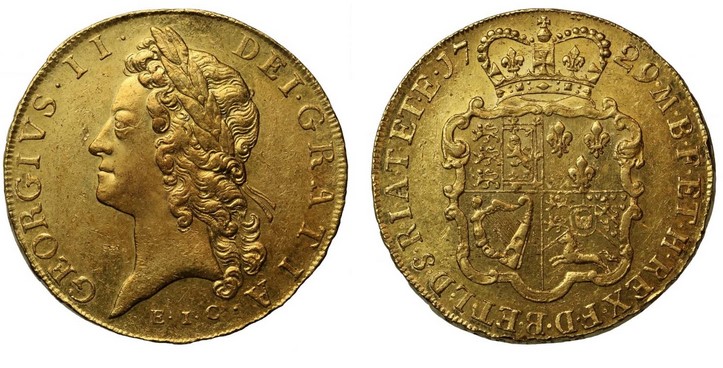
Coins from the reign of George II (1727–1760) are highly prized, particularly those struck from gold provided by the East India Company or from silver captured from Spanish treasure ships (marked “LIMA”.
Most Valuable George II Coins
The following coins represent some of the highest-value issues currently available or recently sold:
Gold Five Guineas (1729 “E.I.C.”): Struck using gold imported by the East India Company, these coins are among the most prestigious in the
Georgian series.
Market Value: A high-grade (MS62) specimen is valued at approximately £85,000. Other examples in Extremely Fine condition typically reach £70,000.
Mintage Information: While precise mintage for this specific year is not recorded, they were struck on a large scale relative to other five-guinea issues of the 18th century.
Gold Guinea (1753): Struck during the later “Old Head” period of his reign.
Market Value: A specimen in MS61 grade is currently offered by The Royal Mint for £22,995.
Mintage Information: This date is classified as “scarce”.
Silver Proof Crown (1746): A machine-made proof coin from the “Old Head” series, notable for its exceptional detail and rarity.
Market Value: Valued at approximately £13,250 for a PF61 grade specimen.
Mintage Information: Classified as “rare” with no precise mintage figures recorded, though production of silver crowns was significantly halted during this period to prevent melting.
Gold Two Guineas (1739 “Intermediate Head”): Features a transitional portrait unique to high-value gold coins.
Market Value: A high-grade (AU58) example is priced at £11,500.
Mintage Information: The total gold output for the year 1739 was recorded at £283,854 in bullion value.