
Achaemenid Gold Daric Coin
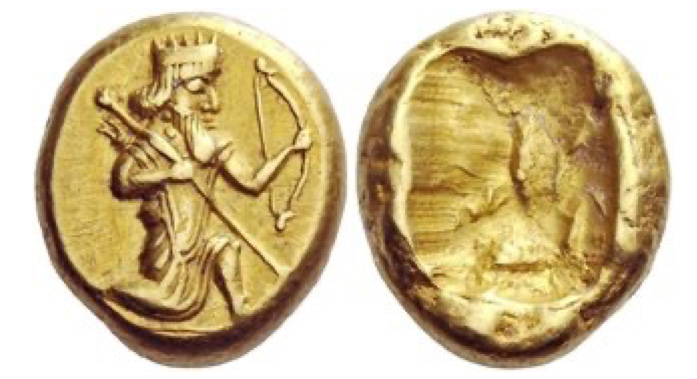
The Achaemenid Gold Daric ( 520–330 BC) was the first gold coin of the Persian Empire and served as a high-value “superregional” currency across the ancient world. Introduced by Darius I, these coins were struck with a remarkable gold purity of 98–99%.
Market Values & Recent Auction Records
The value of a gold daric is heavily influenced by its strike quality and surface preservation, with “Choice” or “Mint State” specimens commanding significant premiums.
| Coin Type / Condition | Approximate Value | Source / Recent Sale |
|---|---|---|
| Gold Daric (NGC Choice AU, 5/5 Strike) | £3,750 ($4,725) | CNG Triton XXIX (Jan 2026) |
| Gold Daric (NGC MS, 5/5 Strike & Surface) | £2,850+ ($3,600) | Goldberg Auction 150 (Feb 2026) |
| Gold Daric (Artaxerxes I–Xerxes II) | £3,811 | MA-Shops UK (Mar 2026) |
| Gold Daric (NGC AU, 4/5 Strike) | £2,525 ($3,200) | Heritage NYINC (Jan 2026) |
| Gold Daric (Standard VF/EF Grade) | £1,450 – £2,000 | Silbury Coins / Baldwin’s |
| Double Daric (Babylon, Extremely Rare) | £5,385 (6,000 CHF) | Numismatica Ars Classica (Feb 2026) |
Mintage & Rarity
While precise ancient records were not kept, numismatic research into Carradice Types provides a proxy for rarity:
- Type II (“King Shooting Arrow”): Struck under Darius I to Xerxes I (c. 505–480 BC). This is the earliest gold daric type and is considered very rare.
- Type III (“King with Spear and Bow”): The most common type, though specific “fine style” variants or those with rare monograms (like the Babylon issues) are scarce.
- Production Volume: These coins were intended as bullion for large state payments and military wages—one daric equalled about one month’s salary for a soldier.
Survival: Though minted for over 150 years, many were melted down following Alexander the Great’s conquest. Modern “Mint State” survivors are prized for their “flawless” artistry and preserved lustre.
Identifying Characteristics:
- Obverse: Depicts the Persian King as a “Royal Archer” in a kneeling-running stance, typically holding a bow and a spear or dagger.
- Reverse: A simple, irregular incuse punch—a traditional anti-counterfeiting measure adopted from the earlier Lydian system.
- Weight: Consistently between 8.1g and 8.5g, based on the Babylonian shekel standard.