
Syracuse Silver Decadrachm Coin
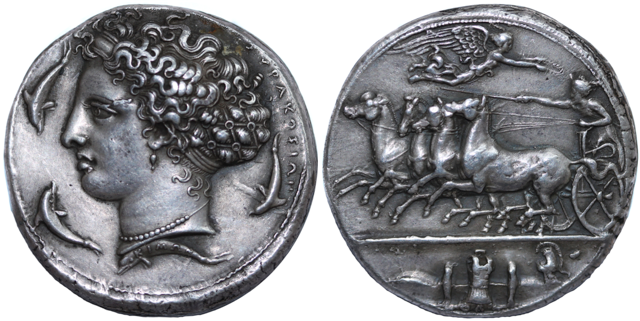
Extremely Fine: Up to: £130,000
The Syracuse Silver Decadrachm (c. 405–370 BC) is frequently cited as the most beautiful coin ever minted, serving as the high-water mark of ancient Greek numismatic art. Commissioned by the tyrant Dionysios I, these massive coins were likely struck to commemorate the Syracusan victory over Athens in 413 BC or to reward military leaders and victors of the local games.
Market Values & Auction Records (2023–2026)
Value is primarily dictated by the specific die engraver—Kimon or Euainetos—and whether the coin bears their signature.
- Top-Tier (Signed by Kimon or Euainetos): Signed specimens command the highest premiums.
- Kimon Signed: A highly realistic, pedigreed specimen recently realized $120,000 (£95,200) in January 2026.
- Euainetos Signed: Generally considered more “idealised,” a signed specimen in Good EF condition hammered for £130,000 in late 2023.
- Mid-Tier (Unsigned / “In the Style of”): These were often struck by apprentices or from unsigned master dies.
- Market Average: Most well-preserved examples fetch between £23,800 and £31,700 ($30,000–$40,000), though exceptional unsigned pieces can exceed £79,000.
- Recent Sales: Unsigned specimens in the style of Euainetos realized approximately 15,000 to 16,000 CHF (£14,200–£15,100) in March 2026.
- Gold Variants (100-Litrai / Double Decadrachm): Small but extremely valuable gold versions also exist.
A “Fine Style” gold specimen recently sold for $92,500 (£73,400) in January 2026.
Mintage & Rarity
Precise mintage records do not exist for the 5th century BC, but rarity is assessed via survivor counts and die studies.
- Total Survival: It is estimated that approximately 1,000 Syracuse decadrachms (including all varieties) survive today.
- Die Rarity: Euainetos-style coins are more common than Kimon-style ones, with more known surviving examples and a higher number of dies recorded for the former.
- The “Demareteion” Exception: An earlier, extremely rare series (c. 465 BC) exists, of which almost no examples appear in private hands; modern reproductions are common but the originals are valued at hundreds of thousands.
Key Identification Features
- Obverse: A charioteer driving a fast quadriga (four-horse chariot) left, being crowned by a flying Nike. Below the exergue line is a display of military harness (athla or “prizes”).
- Reverse: A masterful head of the nymph Arethusa surrounded by four swimming dolphins. Her hair is typically bound by a net or a wreath of reeds, depending on the artist.