
Arwad Silver Shekel Coin
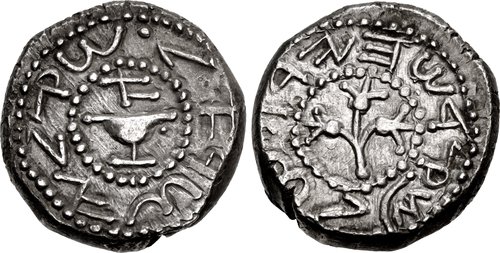
Extremely Fine: Up to: £877,000
The Jewish War Year 1 Prototype Shekel (66 CE) is the most valuable ancient Judean coin ever sold at auction. It was struck in Jerusalem just weeks after the revolt against Rome began, using captured silver stores from the Temple.
Value and Market History
The prototype’s value is driven by its extreme rarity and historical status as the “first” coin of Jewish independence.
- World Record Price: A specimen from the Shoshana Collection sold for $1,105,375 (approx. £877,000) in March 2012 at Heritage Auctions.
- Historical appreciation: This same coin was purchased in 1991 for $240,000, meaning its value more than quadrupled in 20 years.
- Recent Related Sale: An extremely rare Year 5 Shekel (70 CE) realised 28,000 CHF (approx. £26,500) in February 2026.
Standard Year 1 Issues: While prototypes reach seven figures, a standard (non-prototype) Year 1 Shekel in “Good Very Fine” condition is valued significantly lower but remains scarce.
Mintage and Rarity
Precise mintage figures for the 1st century are unknown, but rarity is confirmed by die studies and survival counts.
- Surviving Specimens: There are only four known examples of the Year 1 Prototype.
- One is held in the Israel Museum.
- One was the record-breaking Shoshana specimen.
- The remaining two are in private collections.
- Die Evidence: All four prototypes were struck from the same single set of dies. In contrast, regular Year 1 shekels were struck from at least 10 obverse and 27 reverse dies, indicating the prototype was a strictly limited test run.
Rarity Index: The prototype shekel holds a Numista Rarity Index of 97/100.
Key Identification Features
The prototype differs from the regular Year 1 issue through its more elaborate execution:
- Obverse: Features a ritual chalice with the Paleo-Hebrew inscription “Shekel of Israel” and the letter Aleph (Year 1) above the cup.
- Reverse: Depicts a staff with three pomegranate buds and the inscription “Jerusalem the Holy”.
- Distinctions: Prototypes feature concentric dotted circle borders and more intricate Paleo-Hebrew lettering than the simplified later issues.