Galba Gold Aureus Coin
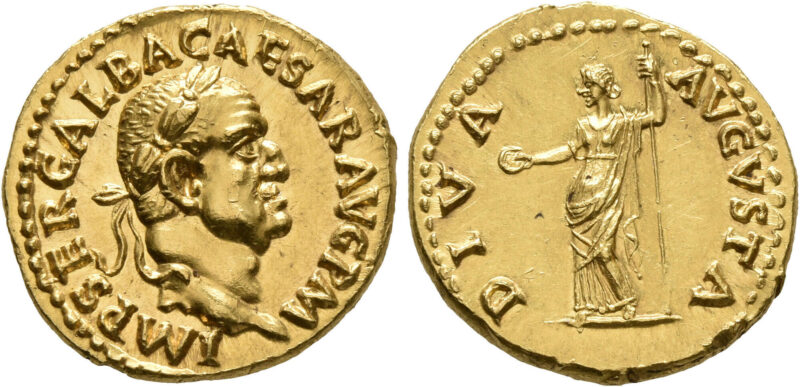
Extremely Fine: Up to: £52,000
Coins from the brief reign of Galba
(AD 68–69) are highly significant as he was the first emperor of the “Year of the Four Emperors” following Nero’s suicide. Due to his short seven-month rule, his coinage is much scarcer than that of the long-reigning Julio-Claudians.
Valuable Galba Coins
Rarity for Galba’s coinage often stems from specific mints, such as Tarraco in Spain, or rare reverse types like those featuring Livia (Augustus’s wife), whose memory Galba sought to honour to legitimise his own rule.
- Gold Aureus (Rome Mint, Livia Reverse): Features Galba’s laureate head and Livia standing, holding a patera and sceptre.
- Market Value: Approximately £8,950 for a specimen with even wear. High-grade (Nearly Extremely Fine) examples can reach £52,000.
- Mintage Information: Exact figures are unrecorded, but it is considered one of the most difficult of the “Twelve Caesars” to obtain in gold.
- Silver Denarius (Tarraco Mint, Livia Reverse): A scarcer provincial issue featuring a brief obverse legend (“IMP GALBA”) and a globe at the base of the emperor’s neck.
- Market Value: Approximately £300 for a rare specimen in close to Very Fine (VF) condition.
- Silver Quinarius (Victory Reverse): A half-denarius silver coin struck at the Lugdunum (Lyon) mint between November AD 68 and January AD 69.
- Market Value: Currently valued around £2,251 for an Extremely Fine (EF) specimen.
- Mintage Information: Very rare in this high-grade condition.
- Bronze Sestertius (Rome Mint): A large bronze denomination; those in high grades or with “LIBERTAS” or “SPQR” reverse designs are particularly valuable.
- Market Value: Ranges from £750 to £1,850 depending on condition. A recent auction realized $20,000 (approx. £15,000) for a high-grade specimen