Henry II Silver Penny
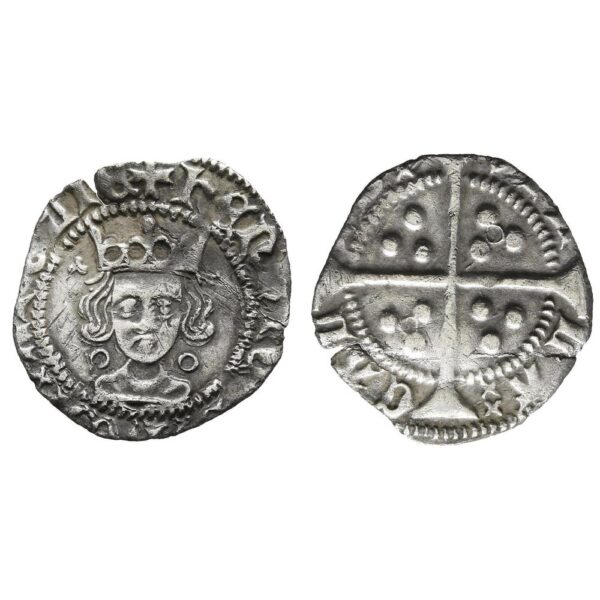
The most valuable and sought-after coins of Henry II (r. 1154–1189) are high-grade specimens of his early “Tealby” Pennies and rare mint/moneyer combinations of his later Short Cross Pennies.
Featured Rare Coin: Henry II “Tealby” Silver Penny (Cross-and-Crosslets)
Struck between 1158 and 1180, these coins are notorious for their poor striking quality, making any specimen with a clear, well-defined portrait exceptionally valuable to collectors.
Design:
Obverse: A crowned, facing bust of the King holding a sceptre.
Reverse: A large cross potent with a small cross potent in each angle (hence “cross-and-crosslets”).
Mintage: While exact figures aren’t recorded, millions were struck at approximately 30 different mints. However, the rarity comes from their condition; most were struck on irregular, wavy flans with large areas of weakness.
Value:
Average Condition: Typically sells for £100 – £300.
High-Grade/Rare Mint: Specimens with strong portraits or from rare mints like Colchester or Newcastle can reach £750 – £850+ at auctions like Spink or Noonans Mayfair.
Notable Variant: Henry II Short Cross Penny (Class 1)
Introduced in 1180 to replace the Tealby type, these coins were of much higher technical quality.
Key Identification: The reverse features a short voided cross with a quatrefoil in each angle.
Mintage: Struck in large numbers across 10 initial mints (including London, Canterbury, and York).
Value:
Common types: Readily available for £50 – £150.
Scarce Mints: Variants from the Worcester Mint (moneyer Godwine) or Oxford Mint (moneyer Sagar) are more valuable, often fetching £250 – £580 depending on the specific sub-class and provenance.