Otho Gold Aureus Coin
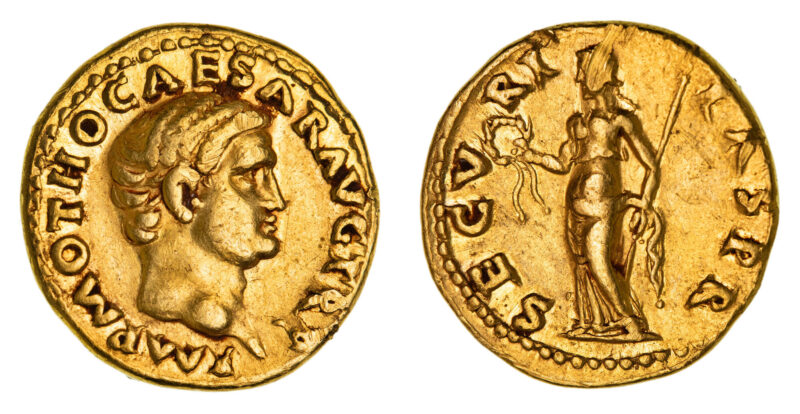
Extremely Fine: Up to: £160,000
Coins from the brief three-month reign of Otho (Jan–Apr AD 69) are among the most difficult to acquire for a “Twelve Caesars” collection. Because his rule was so short and ended in suicide during the Year of the Four Emperors, his coinage is remarkably scarce. Notably, no bronze coins were struck in his name by the Rome mint, making silver and gold the only options for imperial collectors.
Most Valuable Otho Coins
Value is driven by the extreme brevity of his reign and the “bewigged” portraiture, as Otho famously wore a hairpiece to cover his baldness.
- Gold Aureus (Securitas Reverse): Often considered the “holy grail” for Otho collectors, these coins were used to pay bribes to the Praetorian Guard.
- Market Value: High-grade specimens (Choice XF) have realised as much as $204,000 (£160,000). Even examples in “Fine” condition typically reach $10,000 (£7,800) or more.
- Mintage Information: Excessively rare; while exact figures are unknown, they were struck in very small quantities over just 99 days.
- Gold Aureus (Victoria Othonis): A rare type depicting Victory advancing left.
- Market Value: A well-centred, reflective specimen recently sold for $31,000 (£24,300).
- Silver Denarius (Securitas P R): The most “common” of his rare coins, featuring Securitas (Public Security) to project stability during the civil war.
- Market Value: A high-grade (NGC Choice XF) example is currently valued at £10,824. Most standard “Very Fine” (VF) specimens range from £1,100 to £3,900.
- Mintage Information: Struck in small numbers compared to standard imperial silver; survivors are often found worn or with flan cracks.
- Silver Denarius (Pax Orbis Terrarum): Celebrating “Peace of the World,” ironic given the ongoing civil war.
- Market Value: Recent auction results for Very Fine examples range from £1,300 to £2,100.