
The Gold Stater of King Kroisos
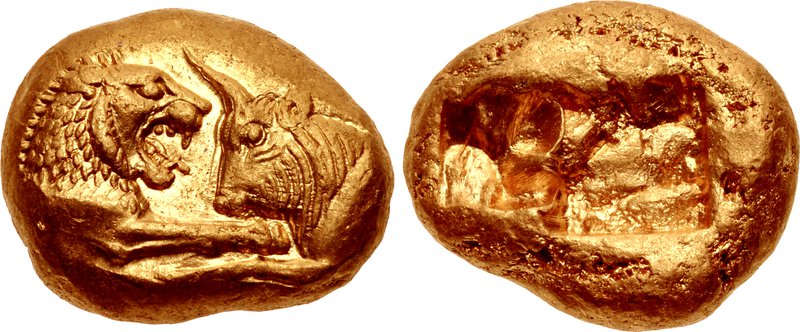
Very Fine: Up to: £308,000
The Gold Stater of King Kroisos (Croesus) of Lydia (c. 561–546 BC) is historically significant as the world’s first true gold coin. Previously, coins were made of electrum, a natural gold-silver alloy; Kroisos’s metallurgists developed the first process to separate these metals, creating a bimetallic system of pure gold and silver.
Values and Recent Auction Results
Due to their historical status as the “prototype” for all subsequent gold coinage, these coins command high premiums, especially for well-preserved “heavy” standard.
| Denomination | Standard | Grade/Condition | Price Realized | Auction Date |
|---|---|---|---|---|
| Gold Stater | Heavy | NGC Choice MS 5/5 – 5/5 | $390,400 (~£308,000) | 12 Jan 2026 |
| 1/24 Gold Stater | Heavy | NGC MS 5/5 – 5/5 | $38,000 (~£30,000) | 12 Jan 2026 |
| 1/12 Gold Stater | Light | NGC Choice MS★ 5/5 – 5/5 | $18,000 (~£14,200) | 12 Jan 2026 |
| 1/12 Gold Stater | Light | Good Fine | 705 CHF (~£625) | 22 Feb 2026 |
Mintage and Rarity
Exact mintage figures for ancient Lydian coins are not recorded, as modern record-keeping did not exist. However, their rarity is defined by their classification and survival:
- Production Tiers: Gold staters were initially minted on a “heavy” standard (~10.7g) before being reduced to a “light” standard (~8.1g) to simplify exchange with silver.
- Survival: “Prototype” heavy staters are exceedingly rare; few examples exist, and even fewer survive in mint-state condition.
- Persian Continuation: After the Persian conquest in 546 BC, Cyrus the Great continued minting Kroisos-style coins for some time, meaning many surviving “Croeseids” were actually struck by the Persians.
Identifying Characteristics
- Obverse: Confronted foreparts of a roaring lion (symbolising Lydia) and a bull (symbolising Hellenic Zeus or strength).
- Reverse: Two incuse square punches of unequal size with irregular interior surfaces.
- Mint: Exclusively struck in Sardis, the capital of the Lydian Kingdom (modern-day Turkey).